Biography
Venkataraman (later to be known as Ramana) was born 30th December 1879 at 1 a.m., in the village of Tiruchuli, Tamil Nadu. The day of his birth was the auspicious Arudra Darshan, which commemorated the manifestation of Lord Siva on earth. Venkataraman was the second of three sons born to Sundaram Aiyar and Alagammal, who both belonged to the Saivite Brahmin caste.
A noteworthy event occurred in November 1895 when Venkataraman met a relative who had returned from a pilgrimage to Arunachala. The very name 'Arunachala' acted as a magic spell on the boy, thrilling him with awe and joy.
Then at the age of seventeen, on 21 August, 1896, Venkataraman was suddenly seized with an overwhelming fear of death. The fear so powerfully concentrated his mind that he began an intense enquiry:
The shock made me at once introspective. I said to myself mentally: Now death has come. What does it mean? What is it that is dying? This body dies. I at once dramatized the scene of death... Well, then, this body is dead. It will be carried to the burning ground and reduced to ashes. But with the death of this body, am I dead? Is the body I? This body is silent and inert, but I feel the full force of my personality and even the sound I within myself — apart from the body. So I am the spirit, a thing transcending the body. All this was not a mere intellectual process. It flashed before me vividly as living truth.
Fear of death vanished once and for all. Six weeks later, taking three rupees, Venkataraman left a short note and departed for Tiruvannamalai, arriving on September 1, 1896. Immediately he went to the Arunachaleswara Temple, tore his dress to make a kaupinam, threw everything else away, and allowed a barber to give him a tonsure.
He would spend about eighteen months within the precincts of the Arunachaleswara Temple. Eventually he moved into an underground cell in the courtyard known as Pathala Lingam. It was there that Sri Seshadri Swamigal found him and brought him to the notice of the world. After several moves he settled in Virupaksha Cave, where he was to live for sixteen years until 1916.
Hymns
Referring to his first attraction to Arunachala, the Sage wrote in one of his hymns:
Oh, great wonder! As an insentient hill it stands. Its action is difficult for anyone to understand. From my childhood it appeared to my intelligence that Arunachala was something very great. But even when I came to know through another that it was the same as Tiruvannamalai I did not understand its meaning. When, stilling my mind, it drew me up to it, and I came close, I found that it was the Immovable.
In 1902 Government official Sivaprakasam Pillai put fourteen questions to the young Swami, which led to the first enunciation of the teaching of Self-Enquiry, later published as 'Who am I?'
In 1907 the scholar Kavyakantha Ganapati Sastri visited and entreated the young sage to enlighten him as to the nature of tapas. Breaking his silence, Venkataraman said: If one observes whence this notion I springs, the mind is absorbed into that. That is tapas. Sastri gave him the name Bhagavan Ramana Maharshi.
In 1916 mother Alagammal joined Sri Ramana at Tiruvannamalai and took charge of the Ashram kitchen. She passed away on May 19th, 1922, and Sri Bhagavan indicated she had attained Liberation. Her body was buried at the foot of the southern slope of Arunachala, and in December 1922 Ramana came down permanently and settled at the base of the Hill, the origin of the present Sri Ramanasramam.
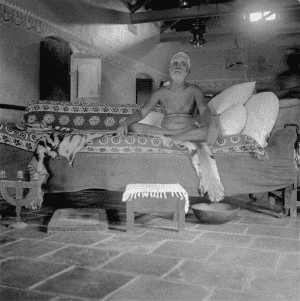
Maharshi consistently guided the seeker back to the source of abiding happiness, one's own Self. Ramana taught that we exist as the Supreme Self at all times and one needs only awaken to this reality by seeking the source of the ego, or 'I-thought', and abide in the Self. He referred to this method as Self-Enquiry.

Ramana's first Western devotee was Frank H. Humphreys, who came to India in 1911 and wrote: On reaching the cave we sat before him, at his feet, and said nothing. We sat thus for a long time and I felt lifted out of myself. For half an hour I looked into the Maharshi's eyes, which never changed their expression of deep contemplation...
Ramana showed the same consideration to animals as to people. The most favoured animal devotee was a cow named Lakshmi, who came to the ashram every day and was treated by Ramana with the utmost grace and kindness. He composed an epitaph for her stating she had attained Mukti (final liberation).
In 1949 a cancerous growth appeared on his left upper arm. Despite four operations, the disease was not cured. The sage was quite unconcerned and supremely indifferent to suffering. He passed away at 8.47 p.m. on Friday April 14th, 1950. At that very moment, a comet moved slowly across the sky, reached the summit of Arunachala, and disappeared behind it.
