
The Importance of Girivalam
The practice of Girivalam, circumambulating the sacred hill, is infused with celestial rhythm. Rooted in verses from the Skanda Purana and adorned with myth, astrology, and ritual, this path transforms the earthly walk into a journey through cosmic grace.
Walking in Silence: The Ancient Instructions
According to sacred verse, a single step around Arunachala sanctifies one's body and mind. The Skanda Purana describes how one should walk slowly, silently, like a woman in the throes of childbirth, mind steady, body composed. Sacred ash, rudraksha beads, and meditation on Shiva mark the devotee. One should imagine brushing past invisible siddhas, devas, and subtle beings, each also moving around the hill. Whether walking alone or singing in devotion with others, the soul is called inward, toward surrender, purity, and awakening.
The Moon and Shiva: A Divine Relationship
Lord Shiva is Chandrasekhara, the One who wears the crescent moon on his head. The moon is not merely ornament. It is power, purity, and mind made manifest. On Sivaratri, when the moon wanes to its thinnest silver sliver, Shiva's meditative potency is strongest. On Poornima, when the moon is full, it radiates blessings, boons, and fulfillment of heartfelt prayers.
At Arunachala, the moon's energy is amplified. Walking Girivalam on a Monday (day of the Moon) or on Poornima is especially potent for those seeking healing, elevation, or a new beginning.

Chandra: The Healer of the Heart
In Vedic tradition, Chandra is more than a celestial body. He is the deity of the mind, emotions, and the nurturing principle. Cool, white, and graceful, Chandra represents intuition, imagination, fertility, and peace. His presence is especially strong at Arunachala, where he is celebrated as a benefic force who blesses those struggling with sorrow, fear, or mental unrest. Worshipping Chandra, especially on Mondays, is said to restore emotional balance, amplify inner sensitivity, and bring one closer to the soft glow of the Self.

Myth and Meaning: The Moon's Gentle Gift
A beautiful tale tells of the Moon, Sun, and Wind visiting their relatives, Thunder and Lightning. Upon returning, only the Moon brings home food for their mother, Star. Sun and Wind had feasted in selfishness; Moon had remembered love. From this myth emerges the Moon's quiet compassion, always giving, always glowing. That same compassion pervades Girivalam under the moonlight, a mother's grace, a healer's touch, a mirror of Shiva's mind.
Lunar Light, Inner Illumination
To walk around Arunachala under the Full Moon is to walk within the field of Chandra's light. It is a time when boons blossom, prayers ripen, and the mind becomes still. Here, fire and moonlight meet. Shiva and Chandra merge. And the path around the Hill becomes a luminous return to the Self.
The Right Way to do Girivalam
Giripradakshinapriya – The One who delights in circumambulation
Among the thousand and eight names given to Arunachala by Adi Shankara, one stands out for its sweet intimacy: Giripradakshinapriya: "The Lord who delights in circumambulation."
At most holy shrines, the deity rests atop a hill. But at Tiruvannamalai, the Hill itself is the Deity. To walk around it, known as Girivalam in Tamil or Giripradakshina in Sanskrit, is not a symbolic act. It is worship in motion, meditation through the body, a return to the center of all centers.
What It Means to Walk the Hill
The Sanskrit word Pradakshina breaks into: Pra – the bestower of boons; Dakshi – the destroyer of karma; Na – the giver of wisdom. Thus, with every step taken with the Hill to your right, you are bowing to the sacred fire that burns eternally as Arunachala.
According to the Ribhu Gita, "I remain fixed, whereas innumerable universes rotate within me." Pradakshina is a deep recognition: all is within the Self, and the Self is Arunachala.

A Path of Light, A Ritual of Grace
In Arunachala Puranam, the Hill is described as the Adi Linga, the primal pillar of light. The pathway encircling it is the sacred Yoni, the source of all creation. Every step is a yajna.
- One step = the merit of a fire sacrifice
- Two = the merit of a Rajasuya Yaga
- Three = the reward of an Ashvamedha Yaga
The Hill is also said to be rich in siddha herbs, and the wind that brushes past it carries their healing aroma to all who walk in devotion. Even the dust lifted by the feet of a pradakshina pilgrim purifies distant lands.

The Outer and Inner Pathways
There are two sacred circuits: the outer path (14 km), lined with temples, tirthams, and the eight cardinal lingams: Indra, Agni, Yama, Niruthi, Varuna, Vayu, Kubera, and Isanya; and the inner path, a subtler trail through the forests and foothills, traditionally walked in silence. Siddhars, mystic sages, are said to dwell unseen across these trails, their presence felt by the sincere.

How to Walk: Rituals of the Round
Scripture prescribes that one should walk slowly, silently, and in a spirit of surrender:
- Barefoot, without umbrella or vehicle
- In clean white clothing, wearing vibhuti
- Avoiding anger, fear, or desire
- Reciting mantras, singing bhajans, or holding inner silence
- Offering alms but accepting none
It is a moving meditation, likened to a queen in her tenth month: dignified, inward, and full of grace.
The Power of the Days: Weekly Girivalam Blessings
Each day of the week offers its own unique spiritual reward when Girivalam is performed:
- Sunday: Union with Shiva's Solar Abode; grants liberation and transcendence.
- Monday: Merges one in Shiva's form; bestows youthfulness and freedom from decay.
- Tuesday: Destroys karmic debt; ends the cycle of death and rebirth.
- Wednesday: Grants divine skill in arts and philosophy; awakens omniscience.
- Thursday: Leads to guruhood; earns veneration among sages and celestial beings.
- Friday: Attains the grace of Lakshmi; aligns with Vishnu's abode of bliss.
- Saturday: Offers planetary protection and worldly success.
When the Stars Align: Auspicious Timings
The benefits of Girivalam increase exponentially on:
- Sivaratri, Tamil New Year, and the three holy months from mid-October to mid-January.
- Solstice Days – where fruits multiply a crore-fold.
- Poornima under Magha nakshatra (Feb–Mar).
- Brahma Muhurta – the sacred pre-dawn hours.
- Solar eclipses, and Vidhipaada Yoga – rare moments of cosmic alignment.
Every Full Moon draws mystics, siddhas, and seekers to the sacred path, when the breeze carries the scent of herbal healing and divine presence is thick in the air.
In the Words of Ramana
When asked why a sadhu only walked the hill and didn't read Vedanta texts, Ramana Maharshi replied: "What better sadhana can there be than going round the Hill?" The path is the teaching. The Hill is the guru. The walk is the awakening.
A Sacred Tradition Across Time
From Goddess Parvati, who was advised by Sage Gautama to walk the Hill daily to fulfill her heart's desire… To Sage Durvasa, who declared that even curses could be lifted only through Girivalam… To King Vajrangada, whose healing came by the same act… The tradition of circumambulating Arunachala lives on, timeless and luminous.
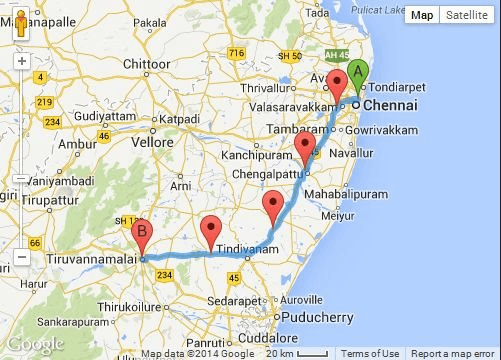
The Girivalam Path
Download the Girivalam Path Map (PDF)

Scriptural Instructions from the Skanda Purana
The Skanda Purana (Chapter 9, verses 34–50) prescribes the following for circumambulation of Sonacala:
"If anyone regularly circumambulates the Lord in the form of Sonacala, he has no rebirth. He shall certainly attain eternity. If a person takes even a step by way of circumambulation, the entire earth is sanctified by coming into contact with the dust of his feet. Without any agitation, without even hearing the sound of his own steps, the devotee should circumambulate in the manner of a woman walks when delivery is imminent. The learned devotee should put on a clean dress after bath. He should apply sacred ash over his body and adorn himself with rudraksa beads. Remembering Siva he should take steps slowly. He should think about the likelihood of collision with thousands of Devas, invisible Siddhas and others of gaseous forms. He must offer different kinds of charitable gifts. He must perform meritorious deeds. He should render assistance to supplicants."
Navagraha Connection: Chandra at Arunachala
Lord Shiva is known as Chandrasekhara, the one crowned by the moon. The crescent on the Lord's head represents the fifth-day moon and signifies that Shiva possesses the power of Soma, co-existent with that of destruction. Even though all the Navagrahas are represented at Arunachala, the moon with its particular association with Lord Shiva has an extraordinary influence.
Sivaratri is the fourteenth day of the lunar fortnight when the moon is most waned, the night when the mind is most tractable and can be easily conquered. Poornima (full moon) is more about the success of boons, vratas, and heartfelt prayers. Doing pradakshina on Monday (the day of Chandra) is particularly helpful if one wishes to start a new project, attain a high elevation in life, or rid oneself of the fear of death.
Chandra represents brain and mind, emotions, sensitivity, softness, imagination, Queen and mother in Vedic Astrology. Worship of the Moon is said to be beneficial for relief from all sorrows and helps in curing mental afflictions.


The Moon's Gentle Gift
Sun, Moon, and Wind went out to dine with their uncle and aunts Thunder and Lightning. Their mother, one of the most distant Stars, waited alone for her children's return. Both Sun and Wind were greedy and selfish; they enjoyed the feast without a thought of saving any for their mother. But the gentle Moon placed a small portion of every dainty dish under one of her beautiful long finger-nails, that Star might also have a share. From this emerges the Moon's quiet compassion: always giving, always glowing. That is why the Moon's light is so soft, cool, and beautiful even to this day.