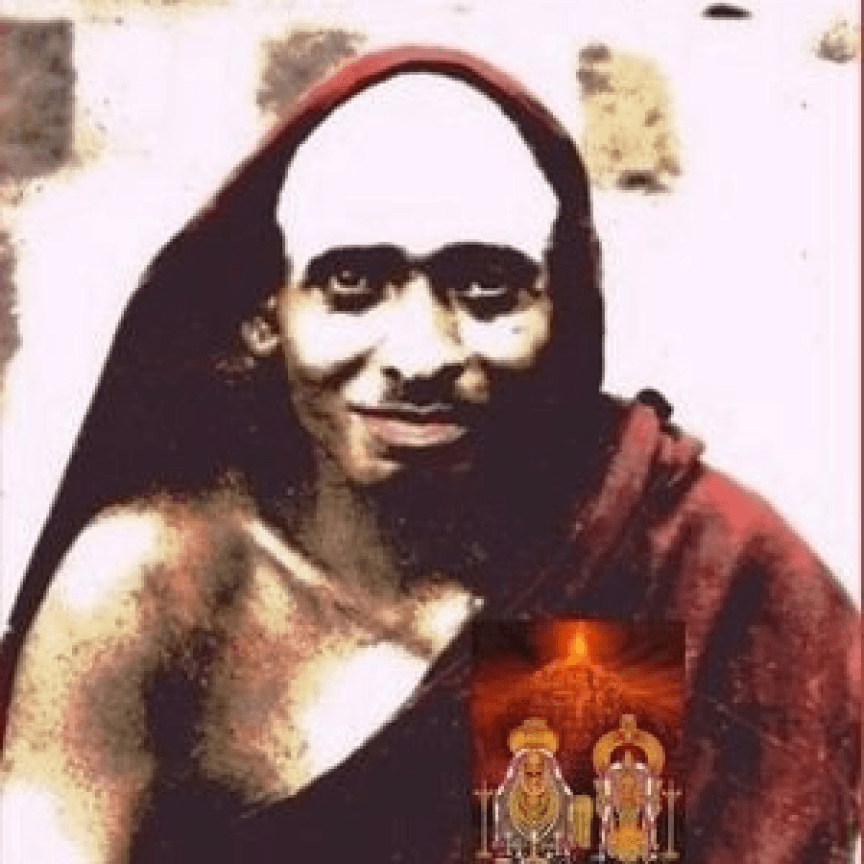
In 1790, Kamakoti Sastri was born into one of the families of the Kamakoti Vamsa in Kanchipuram. In due course, on January 22, 1870 a child was born to Varadarajar and Maragatham. People round about said the radiant child was an ornament of Sri Kamakshi Devi, a pet child of the Goddess, born because of the parent's tapas.
Even from his earliest years the child Seshadri would perform pujas, sit in meditation and go off into spontaneous trances. At four years old he was known as 'The one with the golden hand' after a trader gave away a thousand bronze statues because of the good fortune the boy's touch brought.
At nineteen, after both parents had passed away, Seshadri met Sri Balaji Swamigal, a wandering saint from North India, who gave Seshadri sannyas and instructed him in the Mahavakyas. This was the only guru and formal diksha Seshadri is known to have had. He arrived at Arunachala at nineteen and did not leave for the next forty years, until his mahasamadhi in 1929.
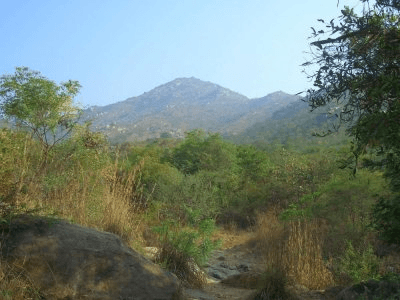
Seshadri Swamigal would meditate at several places in and around the Arunachaleswara Temple. He did not do tapas on the top of the Mountain and instead would go onto the slopes to pray. He often said: 'This is the place where Swamy and Ambal invite all and confer liberation' and 'Lord Krishna leaving aside his sudarshana chakra is playing on his flute. On hearing it Lord Siva who is inside the mountain comes out and dances.'

Seshadri Swami moved about Tiruvannamalai for forty years, an ascetic with total disregard for either name or form. He had no home, dependents, property or any fixed habit. He would often conduct himself like a mad man, roaming in the heat of the day, staring at the midday sun, playing in the rain. He walked fast, made no sound walking, and his body seemed light like a ball.
He was a tapaswi of the highest order. One result of his sadhanas from earliest years was the development of siddhis and psychic powers. He could tell the past and future and read minds. His miraculous touch is said to have cured many who came to him with devotion. He was ever emphasising the inestimable value of giripradakshina:
'One should pray to Lord Arunachaleswara all the time. In particular perambulation of the hills should be done on Tuesdays. Deep devotion will arise.'

Seshadri Swamigal and Ramana Maharshi were contemporaries; it was Seshadri who found Ramana in the Pathala Linga, protecting him from urchins and bringing him to the notice of the world. Locals used to call Sri Seshadri Mother Parvathi and Sri Ramana, Skanda (Lord Subramanya). Sri Ramana said of Swamji: 'Sri Seshadri does not allow people to come near him. Here all are coming.'
Throughout his life Sri Seshadri continuously emphasised the glory of Arunachala: 'This is Siva Lingam. It is enough to worship this. One can become spiritually enlightened and attain liberation.'
One day in 1928 he asked a devotee, 'Shall I build a new house and go away?', meaning he had completed his task and was ready to depart. On January 4, 1929, Sri Seshadri Swamigal left his body. Sri Ramana Maharshi joined the procession at Agni Theertham. The samadhi tomb is now enshrined within the grounds of Sri Seshadri Ashram on Chengam Road, Tiruvannamalai.
'There is a magnetic mountain which attracts all living beings. The moment one thinks of it, it controls the actions of all beings who think of it and attracts them towards itself... Oh! Jivas! Attain liberation by realising the nature of Arunagiri.'