Arunagirinathar was one of Tiruvannamalai's most celebrated saints. A Murugan bhakta who lived at the foot of Arunachala in the fourteenth century. Reliable information about him is hard to come by for the earliest account of his life was not published until the nineteenth century, about 500 years after he died.
Arunagirinathar was born in Tiruvannamalai and spent the greater part of his life there. He was reputed to be the son of a courtesan called Muttammai. As he grew up he found the company of courtesans so attractive, he spent most of his time in their houses.
The major turning point in his life occurred when he had spent all his sister's money. His sister, who had nothing left except the clothes she was wearing, offered him her own body in love. These words deeply affected and shamed Arunagirinathar. He decided to commit suicide by jumping off one of the gopurams in the Arunachaleswara Temple. Before he could jump, Lord Murugan manifested before him and held him back.
Murugan embraced him. Then, with his vel, he wrote a mantra on Arunagirinathar's tongue, gave him a japa mala and commanded him to sing songs in praise of him. Arunagirinathar found that he could effortlessly compose and sing. His diseases vanished and he became an ecstatic bhakta whose devotion manifested as a stream of new songs, all in praise of Murugan.
He toured the town of Tiruvannamalai, composing and singing songs as he went. Traditional accounts say that he composed more than 16,000 songs in praise of Murugan. More than 1,300 of the surviving ones have been collected in a work called Tiruppugazh (The Glory of God), which has become one of the classics of Tamil devotional literature.

Lord Murugan appearing before his devotee Arunagirinathar
In one of his verses he recalls how he transcended his dualistic relationship with God and established himself in the supreme state of Self, utilising the term 'mauna' or 'silence' to convey the essence of this indescribable state.
Although Arunagirinathar seems to have realised the Self fairly quickly, probably because of his latent spiritual maturity, he recognised that most devotees could only progress slowly, step by step. He recommended that devotees should live a life of purity and follow traditional practices.
After his extensive pilgrimages, encompassing at least 200 towns, Arunagirinathar finally returned and settled down in Tiruvannamalai, spending the remainder of his life there.

Kiligopuram, Arunachaleswarar Temple representing the life of Arunagirinathar
With thanks to the Mountain Path.
The below photographs are of paintings on the ceiling of the Mandapam inside the Arunachaleswarar Temple compound, showing significant occurrences in the life of Arunagirinathar.

The saint with his sister Adi trying to persuade her to support his life of debauchery

Arunagirinathar meditating on Lord Murugan, the parrot with the parijata flower, and Lord Murugan revealing himself out of a pillar at Arunachaleswarar Temple
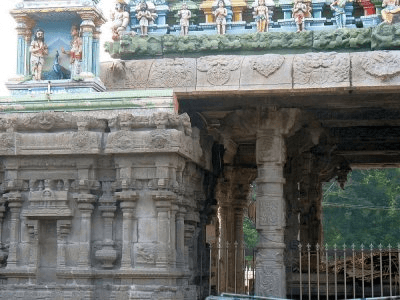
Statues of Lord Murugan with Arunagirinathar standing on top of the pillar from which the Lord appeared at the Arunachaleswarar Temple
