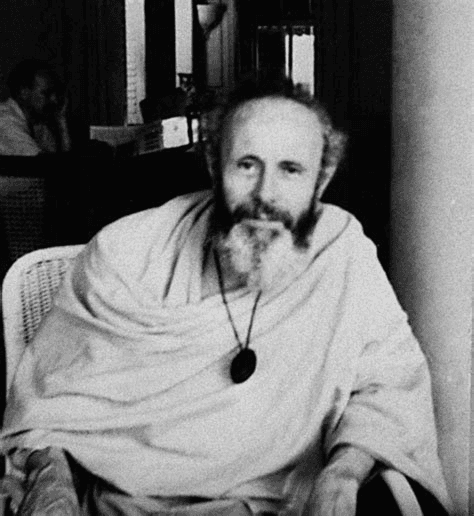
Henry Le Saux
Swami Abhishiktananda was born Henri Le Saux on 30th August, 1910, at St. Briac in Brittany, France. At an early age he felt a calling to the priesthood, and in 1929 entered the contemplative life as a monk of the Benedictine Monastery of St. Anne de Kergonan.
As a monk he was seeking a more meditative way of life and he felt the call of India. He contacted Father Jules Monchanin, who welcomed him: "Learn as much English as you can. You will have no objection to a purely vegetarian diet (essential for the life of a sannyasi). You will need unshakable courage ... complete detachment from the things of the West, and a profound love for India."
Henri Le Saux reached the Indian coast on 15th August, 1948. At the end of January 1949, he took darshan of Sri Ramana Maharshi. The meeting left a tremendous impact, and it is reported that Sri Bhagavan told him, 'Do not meditate — just BE! Do not think you are — just BE! Do not think about being — you ARE!' Some years later Le Saux wrote in his spiritual diary that "Ramana's advaita is my birthplace".
Origin of Ashram at Shantivanam
On 21st March 1950 Henri Le Saux and Father Monchanin started Shantivanam Ashram on the banks of the Kaveri. Le Saux adopted the Indian name Swami Abhishiktananda, "Bliss of the Anointed One", and the kavi robes of a sannyasi. The aim of the ashram was to "bring into Christian life the riches of Indian spirituality and to share in the profound experience of God which originated in the Vedas."
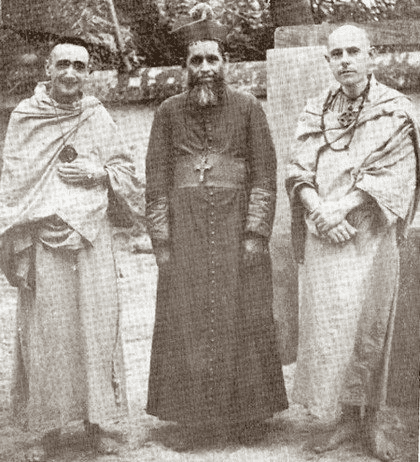
March 21, 1950. Inauguration Saccidananda Ashram, Shantivanam. Henri Le Saux (right), Bishop James Mendonca (centre), Jules Monchanin (Left)
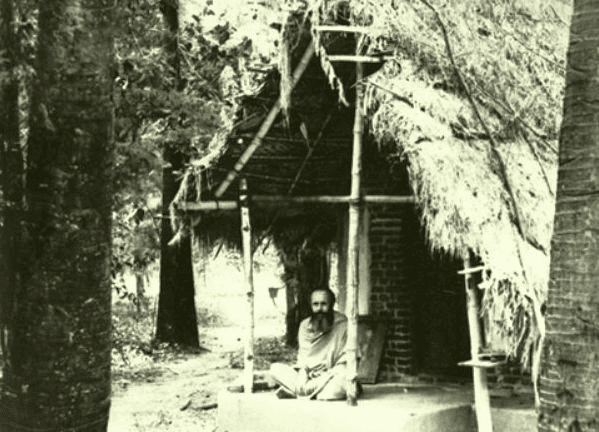
Swami Abhishiktananda at Shantivanam
Swami Abhishiktananda Arunachala Retreats
Arunachala continued to attract Swami Abhishiktananda and in March–April 1952 he moved to Vanatti Cave for a ten-day retreat in complete silence. Spiritual experiences followed, and further retreats over three years allowed him to immerse himself completely in the Direct Teaching of Ramana Maharshi.
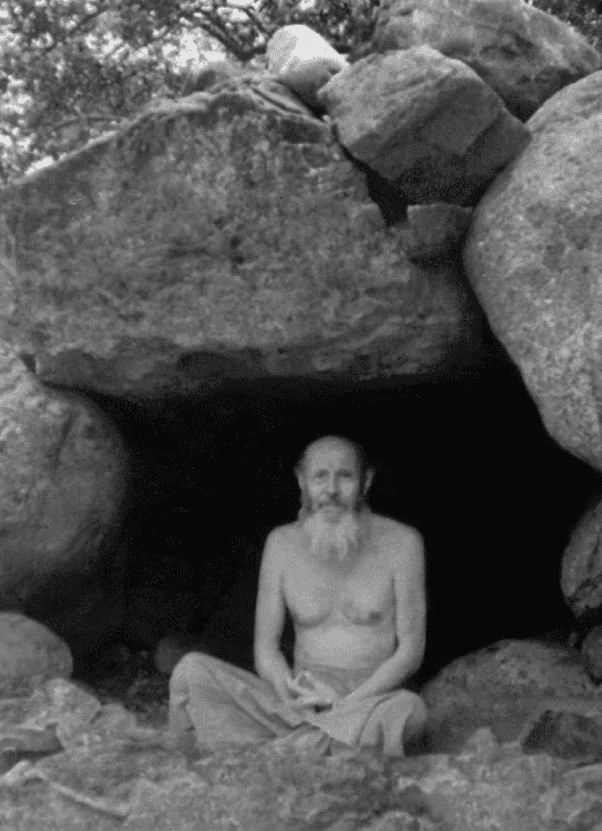
Swami at Arunachala Cave

Swami on Arunachala Summit
Swami with Sri Gnanananda Giri
In December 1955 Swamiji visited Sri Gnanananda Giri at Tirukoyilur and immediately accepted him as his guru. Sadguru Gnanananda became a turning point in his life and Swami Abhishiktananda started realising that the Truth is beyond all religions. Feeling attracted to North India and the Himalayas, he eventually handed Shantivanam over to Father Bede Griffiths in 1968 and relocated to his hermitage in Gyansu, near Uttarkashi.

Sri Gnanananda Giri
In the Himalayas
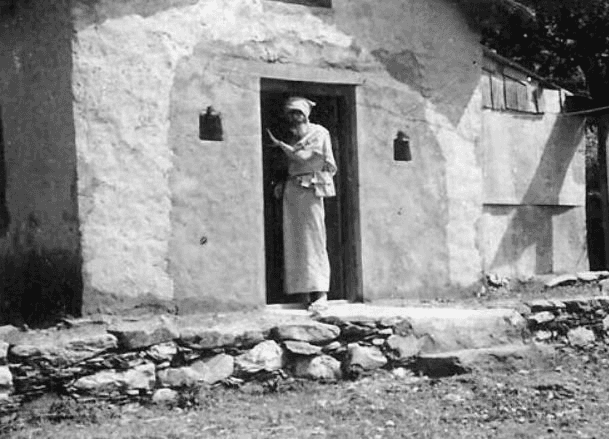
Hermitage at Gyansu, Uttarkashi, Himalayas
Early in July 1973 Swami Abhishiktananda suffered a heart-attack on the road in Rishikesh. He survived for five more months. In the words of his disciple, Swami Ajatananda: "The 'adventure' of the heart-attack, followed by his entry in mahasamadhi, was in truth only the physical expression of his being swallowed up in the great Light, in his Self." Swami Abhishiktananda's Mahasamadhi took place on the 7th of December, 1973.
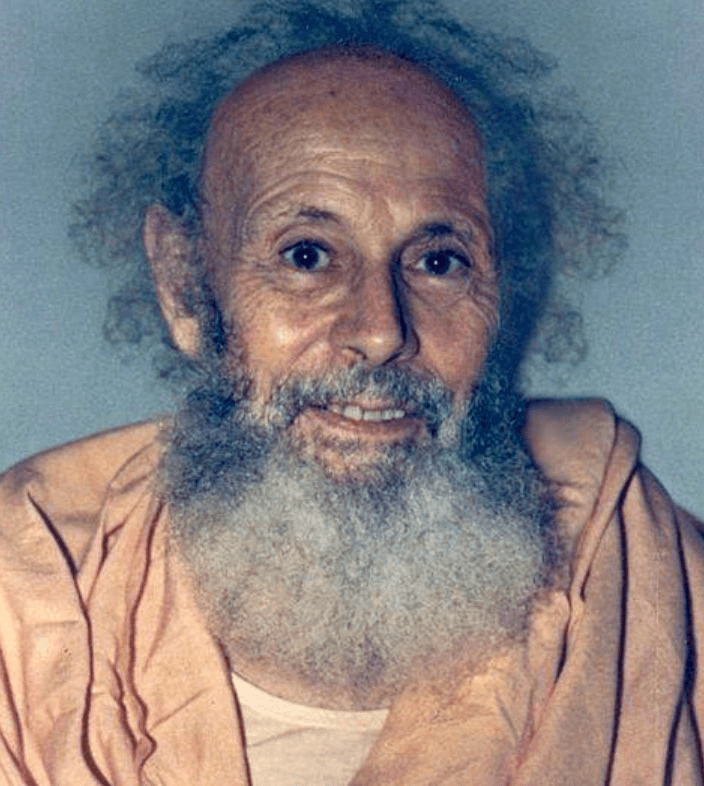
Poem to Arunachala

Arunachala is a symbol
and Arunachala is a Reality,
a high-place of the Dravidian land,
all ruddy, aruna, in the rays of the rising sun,
where is worshipped the linga of fire...
By Swami Abhishiktananda